Sign up / Login
  • Sign-in
  • Sign up

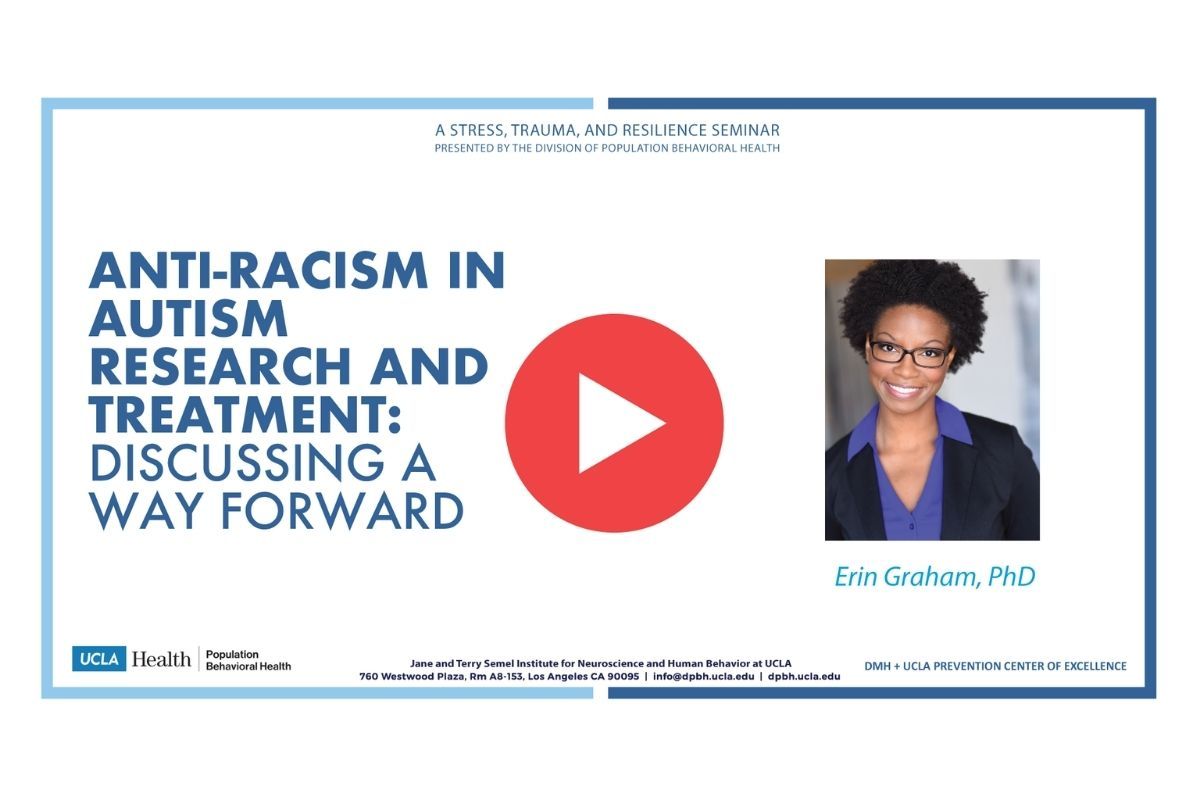
Anti-Racism in Autism Research and Treatment: Discussing a Way Forward
Manage

Add to lists

Only you can see these lists - view your lists on the My Learning page.


Unsave

This will also remove this resource from any lists you have added it to.

Yes, I would like to unsave
detail-img-lg
Type:
  Training
Duration:
1 hour
CE credits:
1.0 CEs
Presented by:
DMH + UCLA Prevention Center of Excellence
Developed by:
UCLA Child and Adult Neurodevelopmental (CAN) REACH Training Program
See more
Series:
Stress, Trauma, and Resilience (STAR) Seminars
Relevant categories:
Behavioral Health Cultural Responsiveness Racial Trauma Systemic Racism
  Access requires that you create an account or login.

Overview


Racial disparities in autism diagnosis, research, and treatment need to be discussed in healthcare. Dr. Erin Graham describes the barriers that minorities, specifically African Americans, face in receiving care and the history behind the cultural reluctance to participate in research. A panel of experts in autism treatment discuss their own experiences serving minority communities and address the importance of cultural humility and diverse representation.

Recorded on: 6/16/2021

  Keywords: anti-racism, developmental disability, provider, racism
  Public link for sharing: https://learn.wellbeing4la.org/detail?id=17170&k=1624557737  
Copied!

Learning objectives


  • Outline the racial disparities in autism diagnosis and treatment
  • Define “anti-racism” and how it can be applied in healthcare
  • Discuss the importance of providers acknowledging the individual lived experiences of diverse communities
  • Demonstrate awareness of one’s own cultural experiences and pre-conceived notions about race

Professional credit


  • This activity offers the following types of credit: APA
  • 1.0 CEs are available.
  • Additional details can be found in the activity document for this resource.

Attachments


  This resource has attachments. To view them, login or sign up.

Related items


An Introductory Course on Autism Spectrum Disorder

This course provides basic information about Autism Spectrum Disorder (ASD) and how it presents in people of various age ranges. It will describe the referral and diagnostic process that families go through when a child has ASD, as well as the various treatment options that are available to them and some common co-occurring conditions. This information will support a better understanding of ASD and how it effects both individuals with ASD and their families.

 Course
  1 hour
  CE credit available
Breaking Barriers: Using Community-Engaged Approaches to Address Trauma and Mental Health Disparities in Immigrant Populations

Ethnically diverse immigrant population can experience socio-cultural, contextual-structural, and clinical-procedural barriers. Become familiar with the application of a community-based participatory research approach to prevention research with Latinx immigrant families. Recorded on: 7/17/2019

 Training
  54 minutes
  CE credit available
  Recorded session available
The Courageous Educator: Addressing Racism and Microaggressions in the Classroom

Our nation's schools can be the most challenging places for students of color. Fortunately, many educators are having the necessary and challenging conversations about race and racism to support and validate them. Here to discuss how we can address racism, microaggressions, and implicit bias in classrooms is Dr. J. Luke Wood, the Associate Vice President for Faculty Diversity and Inclusion and Distinguished Professor of Education at San Diego State University and Dr. Tyrone Howard, a Professor of Education, Director of the Pritzker Center for Strengthening ...

 Video
  33 minutes
Praxis of Intersectionality: Examining our Axes of Power and Oppression to Support Our Anti-Racist Work and Cultural Responsiveness

Review the theory of intersectionality, a framework to actively reflect on axes of power and oppression, and how this subsequently informs interpersonal relationships and subsequent care for others. This recording does not include the interactive dialogue that was a part of the live seminar. Recorded on: 1/20/2021

 Training
  23 minutes
  Recorded session available
The Intersection of Anti-Black Racism and Adolescent Development

This video is the first Council Report from the National Scientific Council on Adolescence (NSCA) and summarizes research on how racism and related inequities impact key developmental milestones of adolescence. In this subsequent panel discussion, report lead Dr. Joanna Williams, co-author Dr. Andrew Fuligni, and youth reviewer Kofi Mason talk about what can be done to eliminate anti-Black racism and mitigate its effects in order to support the healthy development of Black youth.

 Video
  57 minutes
Added on 6/24/2021
Public Partnership for Wellbeing  
Copyright © 2019-2026
University of California at Los Angeles
About   |   Terms   |   Privacy   |   Contact
Way to go!
View your badges
Saved! (Manage)
Unsaved
Changes saved! (Manage)
Are you sure you want to unsave this resource?
To register for this training, you must first sign in to the online learning system.

If you do not have an account yet, click on the Sign Up button -- it only takes a few minutes to register.