Sign up / Login
  • Sign-in
  • Sign up

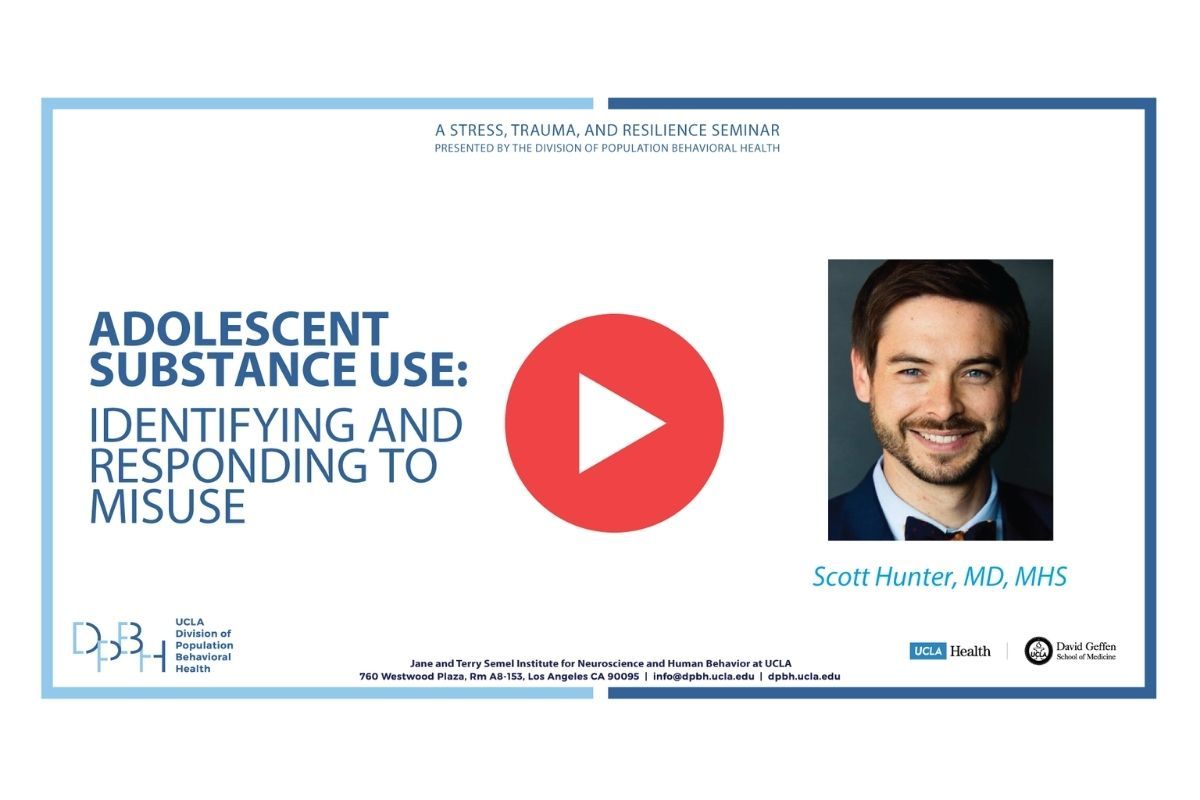
Adolescent Substance Use: Identifying and Responding to Misuse
Manage

Add to lists

Only you can see these lists - view your lists on the My Learning page.


Unsave

This will also remove this resource from any lists you have added it to.

Yes, I would like to unsave
detail-img-lg
Type:
  Training
Duration:
1 hour, 29 minutes
CE credits:
1.5 CEs
Presented by:
DMH + UCLA Prevention Center of Excellence
Featuring:
Scott Hunter, MD, MHS
Series:
Stress, Trauma, and Resilience (STAR) Seminars
Relevant categories:
Behavioral Health School Mental Health Substance Use
  Access requires that you create an account or login.

Overview


Addressing substance use with adolescents is challenging, specifically, if adolescents are not being transparent about their use. Learn to apply best practices for working with adolescents.

Recorded on: 5/16/2018

  Keywords: adolescent, behavior, child, connection, family, parenting, provider, stress, substance use
  Public link for sharing: https://learn.wellbeing4la.org/detail?id=1719&k=1590708738  
Copied!

Learning objectives


  • Apply best practices for encouraging adolescents’ honest reporting of substance use
  • Recognize problematic substance use in adolescents
  • Describe strategies for responding to substance-using adolescents and their parents
  • Evaluate treatment options for adolescents with substance use disorders

Professional credit


  • This activity offers the following types of credit: APA
  • 1.5 CEs are available.
  • Additional details can be found in the activity document for this resource.

Related items


Risky Behavior and Substance Use in Teens Exposed to Trauma

Working with teens exposed to trauma who are engaging in high-risk behaviors can be challenging for the caring adults in their lives. Understanding that trauma is often underlying and driving these behaviors can help approach teens with more compassion, empathy, and a better understanding of how to help them. This book chapter is written to be practical and meaningful for a range of clinical and non-clinical providers working with teens. This chapter also provides an overview of risky behaviors in the context of trauma, uses case examples ...

 Printable Tool
Added on 5/28/2020   ·   Last updated on 11/1/2022
Public Partnership for Wellbeing  
Copyright © 2019-2026
University of California at Los Angeles
About   |   Terms   |   Privacy   |   Contact
Way to go!
View your badges
Saved! (Manage)
Unsaved
Changes saved! (Manage)
Are you sure you want to unsave this resource?
To register for this training, you must first sign in to the online learning system.

If you do not have an account yet, click on the Sign Up button -- it only takes a few minutes to register.