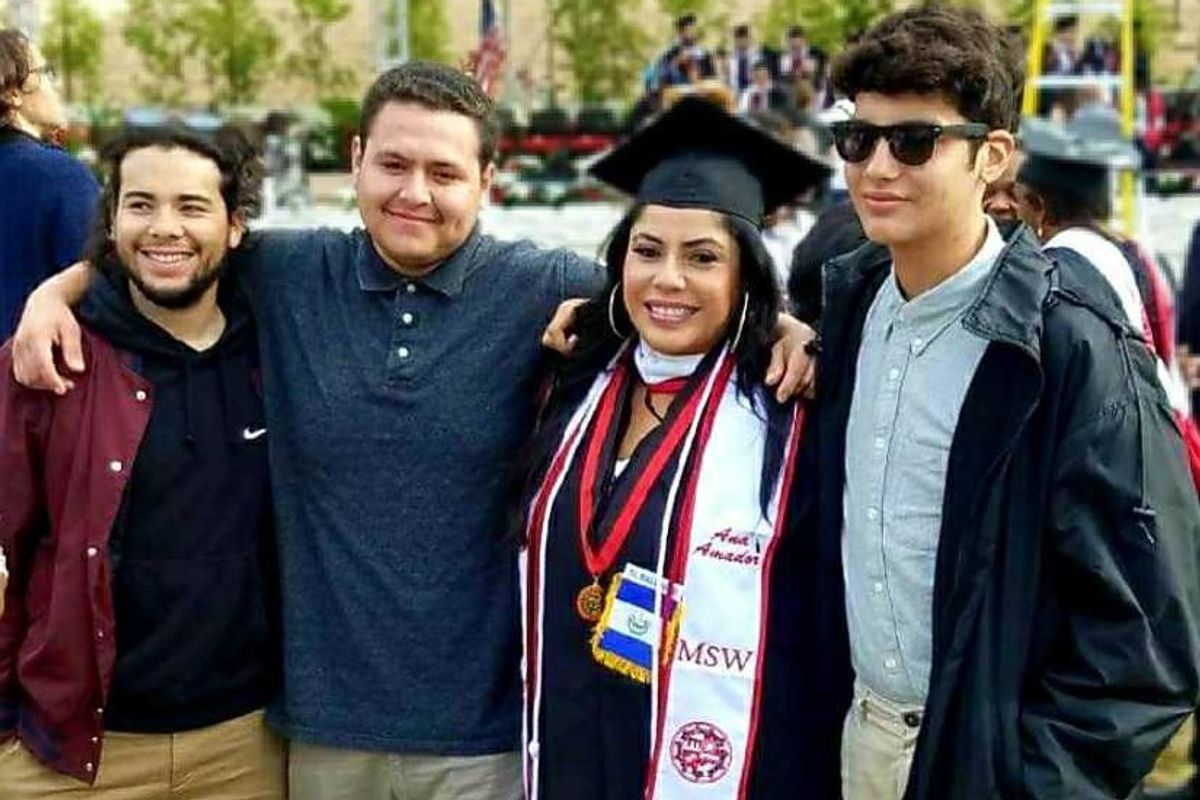
It's 2 pm on a Wednesday, and Ana Amador, a trainer and curriculum developer at UCLA, is wearing her signature hoop earrings — a personal symbol of her truth and resilience in both her life and career. She takes a deep breath and logs into her laptop. Today, she is training on trauma informed and resilience promoting strategies, through Zoom, to a small group of resource parents who have children with intellectual disabilities, developmental challenges, and autism spectrum disorders (ASD).
The training, facilitated entirely in Spanish and designed for nonclinical staff, is the first of its kind at UCLA.
"I created this curriculum with the community in mind," Ana said. "It's important for me to create opportunities for 'la comunidad,' because I know if they had the tools, they would know they can be more than resilient — they can thrive, too."
Ana's dedication to helping others is woven into the fabric of her family. Born and raised in San Luis La Herradura, a small fishing town, in the department (similar to a state in the U.S.) of La Paz in El Salvador, Ana was 2 years old when the Salvadoran civil war commenced. Her father, a university student studying law by day and a member of the Farabundo Martí National Liberation Front (FMNL) revolutionary party by night, would secretly organize farmers and indigenous people in their village to defend themselves against war crimes. His advocacy made him a leader in San Luis La Herradura, but also a prime military target for attack. While his commitment to his community never swayed, he was eventually captured. Ana's mother knew then that it was time to leave.
"We started getting death threats, so our only choice was to leave El Salvador or stay and die," Ana said, "but when we made it to the U.S., my mom left me and my sister with a family she had never met. She went back for my dad, and one year passed before we were reunited again."
Her family settled in Pacoima, California, where Ana now faced a new challenge: she was undocumented. Her parents, frightened of police officers and military officials, advised her to keep her status a secret. For years, nobody outside her family knew. The closer she got to graduating from high school, the more she worried about how she would afford college.
"Knowing my dad never got to finish college after all he endured in El Salvador — almost dying, put in prison only to be tortured — how could I not get my degree?" Ana said, "I felt like I had to continue our legacy, so when I got my citizenship, it was a big relief because now I had a way to pay for school."
In the five years that followed, Ana, now a full-time college student and single mother to two boys, worked hard to build a lasting family legacy of advocacy. She worked first as a special education assistant for children with ASD. Besides focusing her studies on learning how human behavior works, she learned to write grants for nonprofits specializing in ASD. Soon after obtaining her bachelor's degree, Ana began working as a behavioral therapist at the Child and Family Guidance Center (CFGC), a community mental health agency in the San Fernando Valley.
This pivot into mental health is where she felt she flourished. For the first time, Ana interacted and worked alongside social workers, and realized this was something she could do. After working in community mental health for four years, she decided to go to graduate school at California State University, Northridge (CSUN).
At CSUN, Ana's ambition was to become a clinical social worker and embarked on a series of internships. The first was as a medical social worker in the NICU, where she learned how to provide trauma informed support to caregivers with premature infants. Using these skills, she landed an internship at the Veterans Affairs (VA) Sepulveda Ambulatory Care Center as a geriatric social worker, where she developed three curricula and created two of the first mindfulness support groups: one for female veterans, and another for LGBTQ+ people.
After graduating, Ana put her program development work on hold to focus on building her clinical skills and obtaining certifications in several evidence-based practices at CFGC. One day, CFGC contracted with a level 12 to 14 short-term residential therapeutic program (STRTP) group home (the highest level within the state system) that was looking for a strong clinician to work with at-risk youth. Naturally, they turned to Ana, who had, for some kids, become their tenth, fifteenth, or twentieth social worker.
"Working with foster youth changed everything for me," Ana said. "I knew I had to do more — I couldn't do this micro, one-on-one work anymore — I wanted to create change on a macro level. That's when I saw the opening at UCLA."
Ana was looking for a workplace that would allow her to create systematic change on a larger scale. By now, she had accumulated 15 years of hands-on experience working with different populations in schools and within the Los Angeles community. Ana knew it was time to put the program development work she had previously put on hold back into motion.
"I saw that UCLA was looking for a community trainer that would work in collaboration with the Los Angeles Department of Mental Health, and I said 'I can do that! I can train!'" Ana recalled.
One year later, Ana has created four comprehensive workshops for STRTP providers and staff, conducted over 100 trainings, and, with her Los Angeles County Department of Children and Family Services task force team, has trained over 7,000 people. The trainings she designed as an intern at the VA are still in use today. To keep her clinical skills sharp, Ana maintains her private practice, dedicated to incorporating findings from new studies and data into her work.
"My goal has always been to change systems, and I think I've done that here," Ana said. "Working at UCLA helped me find my niche, my purpose, and my own lane, which for me means going back to my roots to work for and with the community."