Sign up / Login
  • Sign-in
  • Sign up

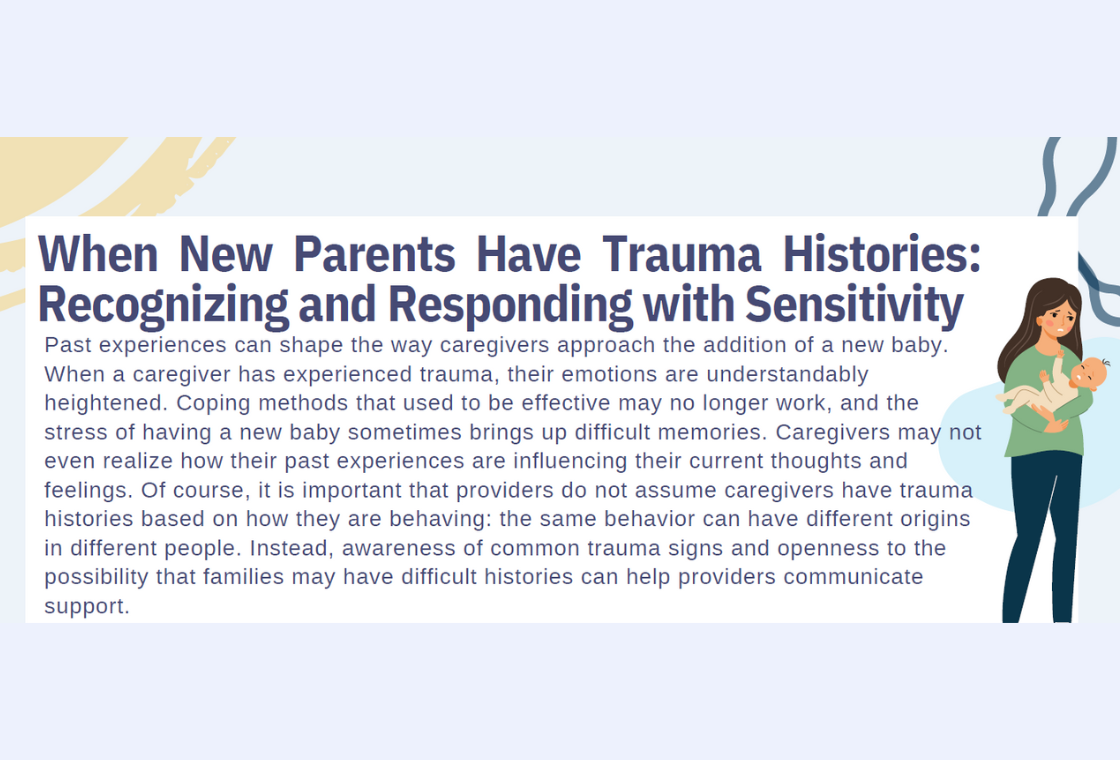
When New Parents Have Trauma Histories: Recognizing and Responding With Sensitivity
Manage

Add to lists

Only you can see these lists - view your lists on the My Learning page.


Unsave

This will also remove this resource from any lists you have added it to.

Yes, I would like to unsave
detail-img-lg
Type:
  Printable Tool
Presented by:
UCLA Child & Youth Behavioral Health Center of Excellence
Developed by:
Family Development Program (FDP)
See more
Relevant categories:
Birth to Five Family Engagement Parenting Support
This is a printable tool.
Click to download and review.
View document

Overview


Past experiences can shape the way caregivers approach the addition of a new baby. This handout gives insight into common trauma signs caregivers can experience, and tips on how to respond with compassion and support.

  Keywords: development, early childhood, historical trauma, NICU, parenting support
  Public link for sharing: https://learn.wellbeing4la.org/detail?id=401479&k=1784069414  
Copied!

Related items


When New Parents Have Trauma Histories: Recognizing and Responding With Sensitivity

Past experiences can shape the way caregivers approach the addition of a new baby. This handout gives insight into common trauma signs caregivers can experience, and tips on how to respond with compassion and support.

 Printable Tool
Feeding Newborns: Inclusive Strategies to Build Empathy and Equity With Families

Feeding is a caregiving act that can bring up a wide range of emotions, including joy, contentment, guilt, worry, and frustration. Providers and clinical staff can help families practice self-compassion throughout their feeding journey by understanding the history and contexts that inform how families approach infant feeding.

 Printable Tool
10 Questions to Ask When Navigating the NICU

Open communication with your healthcare team is essential. Don't hesitate to seek clarification whenever you have concerns or need more information. The NICU staff is there to provide care and support for both you and your baby.

 Printable Tool
Being Responsive to Birth Trauma

Medical providers are in a unique position to reduce the risk for trauma during pregnancy, birth, and postnatal care. This handout will provide some things to consider when interacting with birthing patients.

 Printable Tool
Providing Support for Postpartum Anxiety

Postpartum anxiety is intense worrying after the birth of a child that interferes with daily life. It is a common and treatable condition. Here are some tips for providing empathic, effective support.

 Printable Tool
Supporting Culturally and Linguistically Diverse NICU Families

Neonatal intensive care units (NICUs) serve families from a variety of cultural and linguistic backgrounds. This handout outlines multiple strategies to support linguistically diverse families in the NICU.

 Printable Tool
The Resilient NICU

In this course, some of the basic concepts of trauma and resilience informed care will be examined, with a focus on how to improve the Neonatal Intensive Care Unit (NICU) experience for families and, in turn, improve infant health outcomes. Several situations that may be encountered in the NICU are explored and ways to help alleviate the impact of trauma for families, providers, and the people with whom we work are reviewed. Learn more about the professional credits offered here

 Course
  1 hour
  CE credit available
Added on 1/31/2024   ·   Last updated on 1/31/2024
Public Partnership for Wellbeing  
Copyright © 2019-2026
University of California at Los Angeles
About   |   Terms   |   Privacy   |   Contact
Way to go!
View your badges
Saved! (Manage)
Unsaved
Changes saved! (Manage)
Are you sure you want to unsave this resource?